
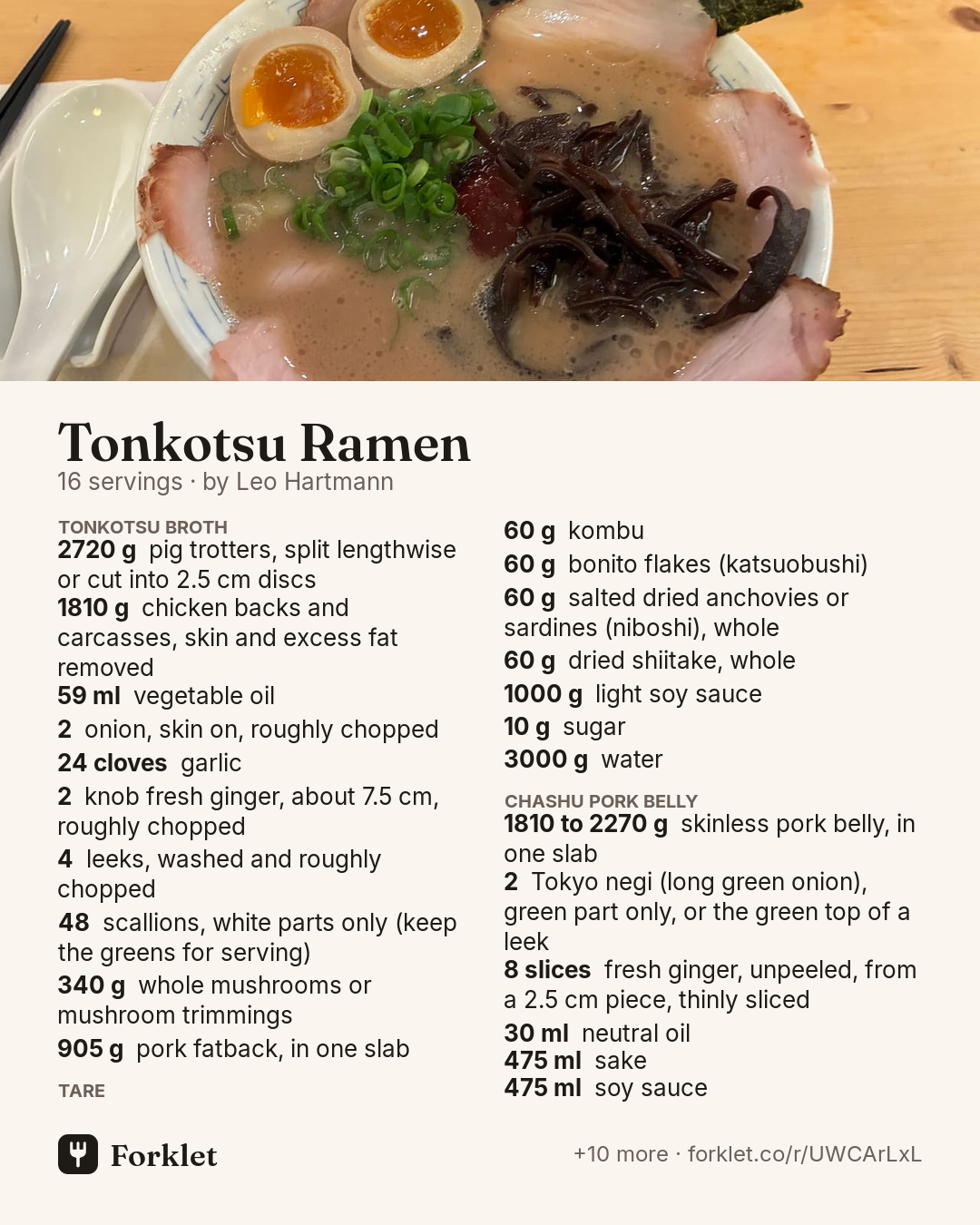
Tonkotsu Ramen
 Leo Hartmann Demo
- Makes
- 16 servings
- Active
- 3 h 34 min
- Total
- 30 h
You’ll Need Large stockpot (at least 12 l), Cast iron or nonstick skillet, Heavy pot or Dutch oven that fits the chashu roll, Butcher twine, Fine-mesh strainer and cheesecloth, Otoshibuta (drop lid) or a round of foil, Zip-top or vacuum bags, Kitchen torch (optional), Immersion blender (optional)
Method
Tonkotsu Broth
-
Put and in the stockpot, cover with cold water and bring to a boil over high heat. Take it off the heat the moment it boils.
[object Object]
-
Meanwhile, heat in the skillet over high heat until it just smokes. Add , and and cook, tossing now and then, until deeply charred on most sides.
blackened in patches all over[object Object]
-
Drain the bones and discard the water. Wash every bone under cold running water, scrubbing off dark marrow and clotted blood; a chopstick helps clear the trotters and chicken spines.
the bones are an even grey-white[object Object]
-
Return the bones to the clean pot with the charred aromatics, , , and . Cover with cold water and bring to a rolling boil over high heat, skimming off the scum as it rises and wiping the rim clean.
the grey scum stops appearing after about twenty minutes[object Object]
-
Set a heavy lid on the pot and adjust the heat so it keeps a steady, rolling boil; check after . Boil until the fatback is completely tender.
a slow rolling boil under the lid, not a simmer[object Object]
-
Lift out the fatback with a slotted spatula, seal it in a container and refrigerate it for the end.
-
Cover again and keep boiling, topping up with water so the bones stay submerged, until the broth is opaque with the body of light cream.
milky white and opaquecoats a spoon like light cream[object Object]
-
Uncover and boil hard over high heat until reduced to about three quarts, just under three litres.
[object Object]
-
Strain through a fine-mesh strainer into a clean pot and discard the solids. For a cleaner soup, strain again through several layers of cheesecloth. Ladle off and discard the liquid fat on top.
Cool and refrigerate the broth for up to 5 days. -
Finely chop the cooked fatback and whisk it into the hot broth.
the fat melts in and the broth turns glossy
Tare
-
Combine , , , , , and in a pot and bring just to a simmer.
[object Object]
-
Take the pot off the heat and let it steep for , then strain and discard the solids.
Refrigerate the tare for up to 2 weeks.[object Object]
Chashu Pork Belly
-
Roll up tightly along its length so the layered meat and fat show at the ends. Tie a double knot of twine round one end, leaving a short tail, then wrap the twine round the roll every 1 cm (⅜ in) as tightly as you can, and knot it back to the tail.
a firm, even log that does not unroll[object Object]
-
Heat in a skillet over high heat and sear the roll on every side, turning it as each side browns.
golden brown all over[object Object]
-
While it sears, put , , and in a heavy pot that fits the roll snugly, with and .
-
Add the seared pork and bring to a boil over medium heat. Skim off the foam, then turn the heat to low.
[object Object]
-
Lay a drop lid directly on the pork and simmer gently, turning the roll every , until tender and the liquid has reduced a little.
a skewer slides into the thickest part with little resistance[object Object]
-
Let the pork cool slightly, then put it in a bag or snug container with about half a cup of the strained braising liquid; in a container, the liquid should come 2.5 cm (1 in) up the sides. Strain and keep the rest of the liquid. Refrigerate overnight.
Safe to pause here[object Object]
-
Next day, cut off the twine and slice the roll 6 mm (¼ in) thick. Lift the solidified fat off the saved sauce and strain it again. Just before serving, sear the slices with a kitchen torch or under a hot broiler.
the cut fat edges blister and turn golden
Ajitama (Marinated Eggs)
-
Whisk , , and in a small saucepan until the sugar dissolves. Bring to a boil, simmer , then cool completely.
[object Object]
-
Bring a saucepan of water deep enough to cover the eggs by 2.5 cm (1 in) to a full boil. Lower in one at a time with a ladle and keep the water at a gentle simmer for , so the eggs do not knock about.
100 °C[object Object]
-
Move the eggs straight into iced water and leave them until completely cold.
[object Object]
-
Crack each egg at the wide end and peel toward the tip, dipping it in the iced water to help the shell come away.
whites smooth and unbroken -
Put the eggs in a bag with the cooled marinade, press out the air and seal it just above the eggs so they stay submerged. Refrigerate, turning now and then.
the whites are evenly tanSafe to pause here[object Object]
Mayu (Black Garlic Oil)
-
Put and in a small saucepan over medium-low heat and cook, stirring now and then, until the garlic is very dark brown. Turn the heat to low and keep going until it is black, then take it straight off the heat.
the garlic is uniformly black, not just dark brown[object Object]
-
Pour into a heatproof bowl and cool completely, then blend until no garlic bits remain and the oil is evenly black. Refrigerate in a jar.
Safe to pause here
To Serve
-
Bring to a boil in a large pot. Thinly slice the reserved scallion greens and halve the eggs lengthwise.
-
For each bowl, bring an eighth of the the tare and an eighth of the the tonkotsu broth to a boil together in a small pot. For an extra creamy, frothy soup, blend it briefly with an immersion blender. Warm two slices of chashu in the soup.
taste: rich and well seasoned, not harsh -
Cook one portion of at a time in the boiling water, about for fresh noodles, then drain well.
springy, with a little bite at the centre[object Object]
-
Pour the hot soup into a warmed bowl and add the noodles. Top with the chashu, an egg, a pile of scallion greens and a few drops of the mayu (black garlic oil). Serve at once.
From Leo Hartmann
Tonkotsu gets its creamy body from a hard, rolling boil that emulsifies the fat and collagen from pig trotters into the broth, so this pot stays at a busy bubble rather than a gentle simmer. The chashu and eggs are made the day before, which spreads the work over two days and lets their flavour settle.
Notes
- Plan it over two days. Day one: start the broth early, then make the tare, chashu and eggs while it bubbles. Day two: slice the chashu and assemble.
- Keep it boiling. A lazy simmer gives a clear stock; tonkotsu needs a steady rolling boil to turn opaque and creamy. Keep the bones submerged, topping up with water as needed. If you must leave the pot, top it up, turn it to the lowest heat, and bring it back to a boil when you return.
- Bones: ask the butcher to split the trotters lengthwise or cut them into discs. Chicken backs add a cleaner savoury note.
- Tare ratio: each bowl takes about 200 g of tare and 350 g of broth. The tare here is a diluted dashi-soy style, so taste a spoonful of the mixed soup and adjust with more broth or tare.
- Chashu sauce keeps a month in the fridge; use it on rice, in stir-fries or to marinate the next batch of eggs.
- Noodles: use fresh or frozen ramen noodles, about 140 g per bowl, cooked briefly in a separate pot of unsalted boiling water.
- Mayu is optional but classic in Kumamoto-style bowls; it tastes burnt on its own and is only used by the teaspoon.
Storage
Broth keeps 5 days in the fridge or 3 months frozen. Chashu keeps 7 days in the fridge or a month frozen. Eggs are best within 3 to 4 days; take them out of the marinade once they taste right.
Make Ahead
Make the broth, tare, chashu and eggs a day or more ahead. Reheat the broth to a boil before assembling.
When to Start
Plan backwards from a time
Filed under Main · East Asia › Japan · Pork · Noodles · Soup · Braising · Weekend Project · Tonkotsu Ramen. Tags: #make-ahead, #project cooking.


Cooked It?
Sign in to say you cooked it.
Questions
No answered questions yet.
Sign in to ask the author a question or suggest a fix.