
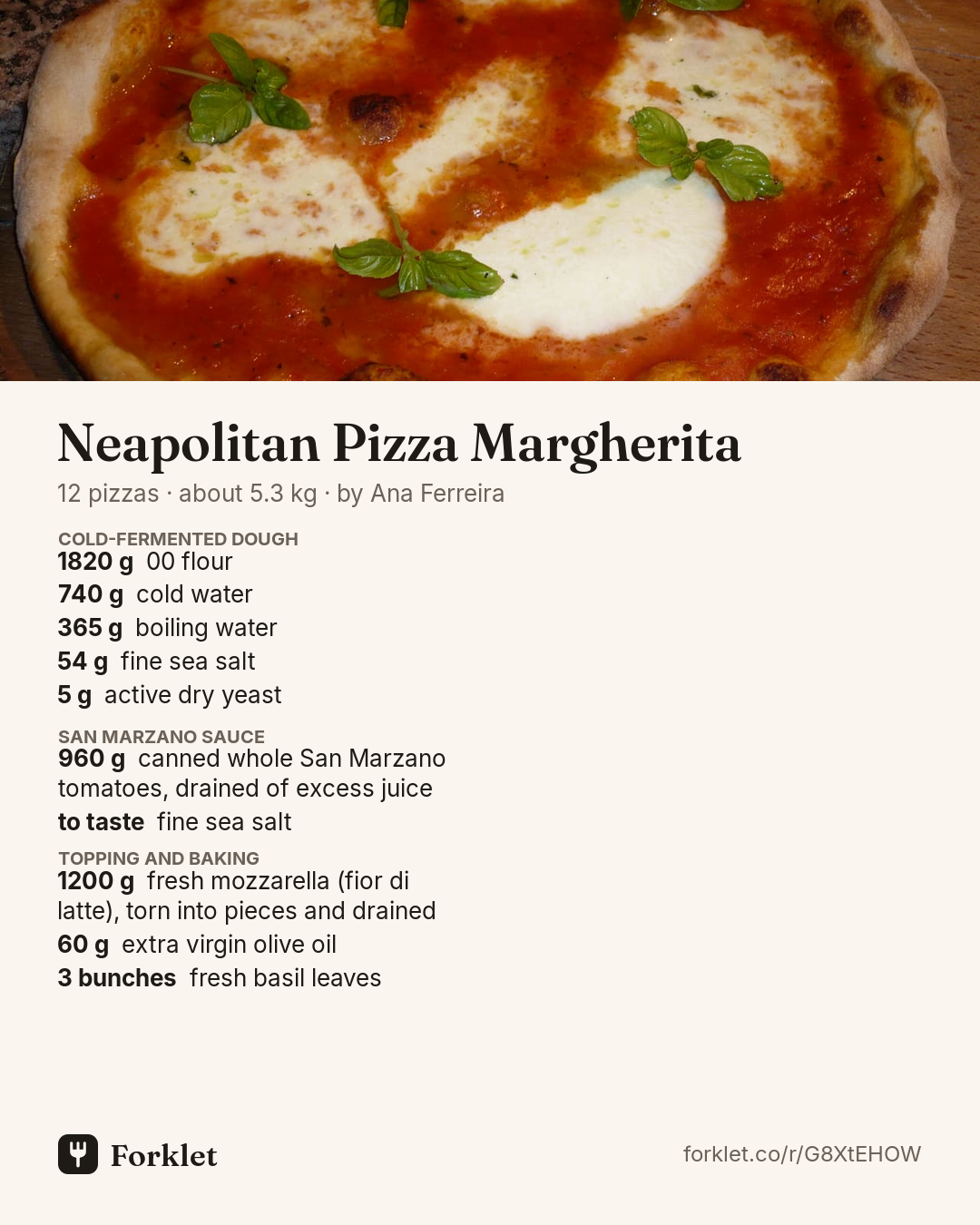
Neapolitan Pizza Margherita
 Ana Ferreira Demo
- Makes
- 12 pizzas · about 5.3 kg
- Active
- 40 min
- Total
- 29 h 50 min
You’ll Need digital scale, pizza oven (wood, gas or pellet fired, reaching 450 to 500 C) or home oven with a baking steel or stone and a top broiler, pizza peel, infrared thermometer, large bowl or stand mixer with dough hook, bowls or a covered tray for the dough balls
Method
Cold-Fermented Dough
-
Pour the into a large bowl, then add the straight off the boil. Check the temperature: between 40 °C and 46 °C suits dry yeast.
43 °C ± 3 °C -
Whisk the and into the warm water until dissolved.
[object Object]
-
Tip in the and stir with a wooden spoon until a shaggy dough forms, then work it with your hand until it gathers into a ball. In a stand mixer, add the liquid gradually to the flour on low speed.
[object Object]
-
Turn the dough onto a lightly floured surface () and knead with both hands for about . In a mixer, run the dough hook on low for .
smooth, firm and springya small piece stretches thin without tearing straight away[object Object]
-
Return the dough to the bowl, cover tightly with plastic wrap and refrigerate for .
4 °Croughly doubled in sizeSafe to pause here[object Object]
-
Take the dough from the fridge and divide it into 12 equal pieces. Shape each into a tight, smooth ball by folding the edges underneath.
[object Object]
-
Set the balls in separate bowls or spaced out on a tray, cover with plastic wrap and leave on the counter for about .
22 °Cballs have doubled and feel soft and airya fingertip dent springs back slowly[object Object]
San Marzano Sauce
-
Crush the by hand or with a fork into a rough, pulpy sauce and season with a little . Do not cook it; it cooks on the pizza.
loose but not watery; pour off thin liquid if it poolsSafe to pause here[object Object]
Topping and Baking
-
Pizza oven: fire it up until the centre of the stone reads 450 °C to 500 °C on an infrared thermometer.
450 °C[object Object]
-
Home oven instead: set a rack in the middle with at least 20 cm (7 ¾ in) clearance below the broiler, put a baking steel or stone on it and heat the oven to its maximum, 260 °C to 290 °C. Hold it at temperature for at least so the steel heats right through.
275 °C ± 15 °C[object Object]
-
Dust the counter and peel with . Press one dough ball into a flat disc with your fingertips, working from the centre outwards and leaving a 1 cm (⅜ in) rim untouched. Lift it and pinch gently around the edge, letting gravity stretch it to about 30 cm (11 ¾ in).
the base is thin enough to see light throughthe rim is puffy and untouched[object Object]
-
Lay the base on the peel. Spread a quarter of the sauce over it, leaving the rim bare, then scatter over and drizzle with .
the pizza slides freely when you jiggle the peel[object Object]
-
Pizza oven: slide the pizza onto the stone and bake for , turning it a quarter turn every so it colours evenly.
480 °C ± 30 °Crim puffed and spotted with dark blisterscheese just melted, centre still soft[object Object]
-
Home oven: slide the pizza onto the steel and bake for about ( on a stone), then switch to the top broiler for more, watching closely and turning as needed. Let the steel reheat for a few minutes between pizzas.
275 °C ± 15 °Cbase crisp and freckled underneathrim charred in spots, cheese bubbling[object Object]
-
Scatter whole leaves over the pizza the moment it comes out, slice and serve at once. Repeat with the remaining dough balls.
From Ana Ferreira
The dough uses barely a pinch of yeast and spends one to three days in the fridge, which builds flavour and gives a light, airy, leopard-spotted rim. The topping is kept deliberately sparse so the bake stays fast and the centre stays soft and wet in the Neapolitan way.
Notes
- Yeast options. For 1.6 g active dry yeast you can use 1.4 g instant yeast or 4.1 g fresh yeast. A 0.1 g scale makes this easy; otherwise a scant 1/2 teaspoon of dry yeast is close.
- Water temperature. Mixing two parts cold water with one part just-boiled water lands at about 35 to 38 C, right for fresh yeast; aim for 40 to 46 C with dry yeast.
- Mozzarella. Tear fior di latte (cow's milk mozzarella) and let it drain in a sieve for an hour so it does not flood the pizza. Buffalo mozzarella is even wetter; drain it longer.
- Sauce. The tomatoes are not cooked before baking: crush good San Marzano tomatoes by hand with a little salt and nothing else.
- Home oven. A baking steel conducts heat faster than a stone and gets closer to a pizza oven. Give it a full preheat; the broiler finish browns the top before the base overcooks.
- Bigger pizzas. The same dough makes three 40 cm pizzas from 330 g balls.
Storage
Baked pizza is best eaten straight away. Leftover slices keep covered in the fridge for up to 3 days; reheat in a hot pan or oven.
Make Ahead
The dough must be made 1 to 3 days ahead. Dough balls can also be frozen after dividing; thaw them in the fridge overnight, then give them their room-temperature rise.
When to Start
Plan backwards from a time
Filed under Main · Southern Europe › Italy › Campania · Cheese · Pizza · Baking · Bread Making · Fermenting · Pizza Napoletana. Tags: #long ferment, #weekend project, #wood fired.


Cooked It?
Sign in to say you cooked it.
Questions
No answered questions yet.
Sign in to ask the author a question or suggest a fix.