
Cassoulet
 Tom Ashworth Demo
- Makes
- 30 servings
- Active
- 1 h 43 min
- Total
- 48 h
You’ll Need Ovenproof stainless steel or enamelled cast-iron casserole (8 to 9 litres), Earthenware cassole (5.5 to 6 litres, at least 10 cm deep) or deep ovenproof bowl or two smaller earthenware dishes, Large saucepan, Food processor, Kitchen string, Large frying pan
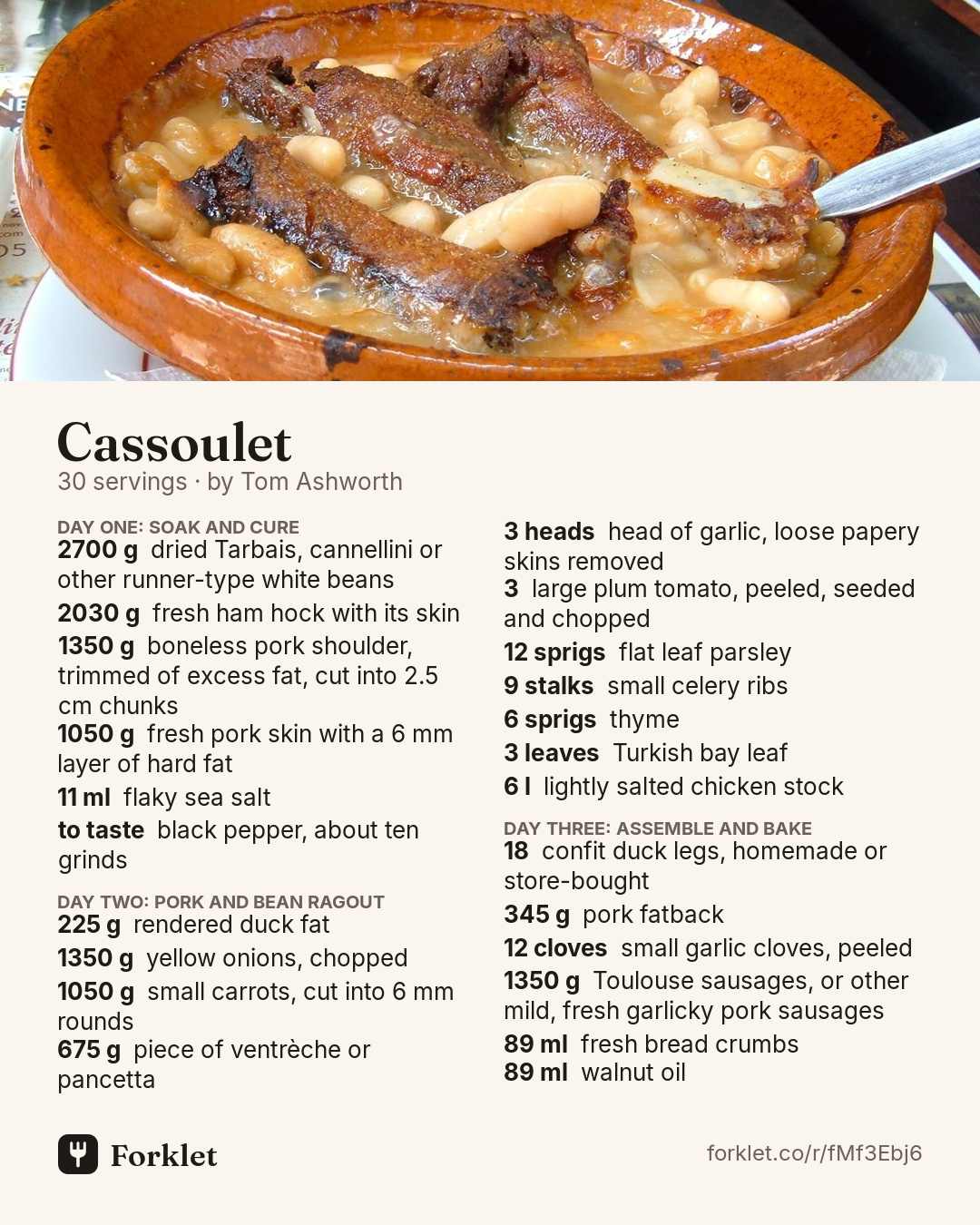
Method
Day One: Soak and Cure
-
Rinse and pick them over for grit. Cover with cold water by at least 5 cm (2 in) and leave to soak in the fridge overnight.
4 °C[object Object]
-
Lay , and in a shallow dish and sprinkle with and . Cover and refrigerate overnight.
4 °C[object Object]
Day Two: Pork and Bean Ragout
-
Put the pork skin in a saucepan, cover with water by 2.5 cm (1 in) and bring to a simmer over medium heat. Cook for about , until plump and supple. Drain and cool.
the skin is soft and pliable enough to roll[object Object]
-
Roll the skin up with the skin side outwards and tie it securely with kitchen string. Tie , , and into a bouquet.
-
Pat the ham hock and shoulder dry. Heat in the large casserole over medium-high heat, add the shoulder and cook, turning now and then, for about , until lightly browned on all sides.
light brown on every side[object Object]
-
Add and and sauté, stirring, for about , until the onions are soft and golden.
[object Object]
-
Nestle in the ham hock and and cook, turning occasionally, for about , until they are a little browned at the edges.
[object Object]
-
Add and and cook, stirring, for .
[object Object]
-
Add the rolled pork skin and the herb bouquet and pour in . Bring to the boil, skimming off the scum, then turn the heat to low, cover and simmer gently for .
the barest simmer, a bubble breaking now and then[object Object]
-
Once the ragout has had its first hour, drain the beans, put them in a large saucepan and cover with fresh tepid water by 2.5 cm (1 in) to 5 cm (2 in). Bring slowly to the boil, skimming, then simmer for and drain immediately.
[object Object]
-
Add the beans to the simmering pork, cover again and simmer until the beans are fully tender, at least and up to depending on their age and type.
a bean crushes easily against the roof of your mouthfully cooked: they will not soften any further in the oven[object Object]
-
Take off the heat, let cool, cover and refrigerate overnight.
4 °CSafe to pause here[object Object]
Day Three: Assemble and Bake
-
Heat the oven to 163 °C.
163 °C -
Lift off the fat that has set on top of the chilled ragout, keeping two tablespoons of it aside. Set the ragout over low heat and warm it to room temperature.
-
Warm to soften the fat: sealed pouches go into a bowl of hot water for about ; homemade legs go on a foil-lined sheet in the oven. Pull the meat off in large chunks, discarding the skin, bones and any large dark veins.
[object Object]
-
Pick out the head of garlic, squeeze the soft pulp from each clove back into the ragout and discard the herb bouquet. Lift out the ham hock and ventrèche, discard the bone, large fatty pieces and skin, and cut the meat into 2.5 cm (1 in) cubes.
-
Untie the pork skin, cut it into 5 cm (2 in) pieces and lay them fat side down over the bottom of the earthenware cassole.
fat side down stops the beans sticking -
Purée with in a food processor. Stir the purée into the ragout, bring to a simmer over low heat and cook for . Take off the heat and fold in the cubed hock and ventrèche.
[object Object]
-
With a slotted spoon, spread half the ragout over the pork skin, letting the liquid drain back into the pot. Scatter over the duck, then cover with the rest of the ragout.
-
Taste the cooking liquid (it rarely needs salt) and ladle in just enough to cover the beans, leaving at least 2.5 cm (1 in) of space below the rim. Dot the top with the reserved fat.
-
Bake for .
163 °Ca brown skin has formed over the beans[object Object]
-
Meanwhile prick in several places and brown them in a frying pan over medium-high heat, turning a few times, for about . Cut long ones into 7.5 cm (3 in) to 10 cm (4 in) pieces.
browned all over[object Object]
-
Take the cassoulet out and lower the oven to 135 °C. Gently break the skin on the surface without disturbing the layers underneath, push the sausages partway down into the beans, evenly spaced, and dust with .
135 °C -
Bake for more. For a darker crust, raise the heat to 204 °C after the first , and if it is still pale at the end, run it under the broiler for with the rim about 18 cm (7 ⅛ in) from the element.
135 °Ca richly browned, crackly crustbubbling at the edges[object Object]
-
Let the cassoulet rest for , on a cloth if the dish is earthenware. Drizzle with just before serving and ladle onto warm plates.
[object Object]
From Tom Ashworth
This is Paula Wolfert's version, learned from a Toulouse home cook famous for hers, and it takes three unhurried days. The pork is lightly cured overnight, the beans finish cooking in a dense pork ragout and rest in it overnight, and on the last day everything is layered with duck confit and baked twice so the beans turn plush under a dark crust. The shopping is the real challenge: track down fresh pork skin and an uncured hock.
Notes
- The beans: Tarbais beans are worth seeking out; they soak up the most flavour and hold their shape through the long cooking. Cannellini or other runner-type white beans work, and Ayocote Blanco beans (the Mexican beans the Tarbais were bred from) are a good stand-in.
- Fresh pork skin and a fresh, not smoked or cured, ham hock are what give the beans their silky body. Ask a nose-to-tail butcher.
- Ventrèche is French-style pancetta; Italian pancetta is the substitute.
- The pot: a traditional clay cassole is narrow at the base and wide at the rim, which gives the most crust. Any 5.5 to 6 litre earthenware dish or ovenproof bowl at least 10 cm deep works. To use two smaller dishes, keep all quantities the same and double the bread crumbs.
- Halving the recipe: halve everything except the sausages, so everyone still gets a piece.
- Tomato: a tablespoon of tomato paste can replace the fresh tomato.
Storage
Leftovers keep for 3 days in the fridge; reheat gently in a low oven with a splash of stock.
Make Ahead
The method is built around making it ahead: day one is a short evening job, the ragout rests overnight before the final bake on day three.
When to Start
Plan backwards from a time
Filed under Main · Western Europe › France · Legumes · Pork · Casserole · Slow Cooking · Weekend Project · Cassoulet. Tags: #feeds a crowd, #three day project, #winter.