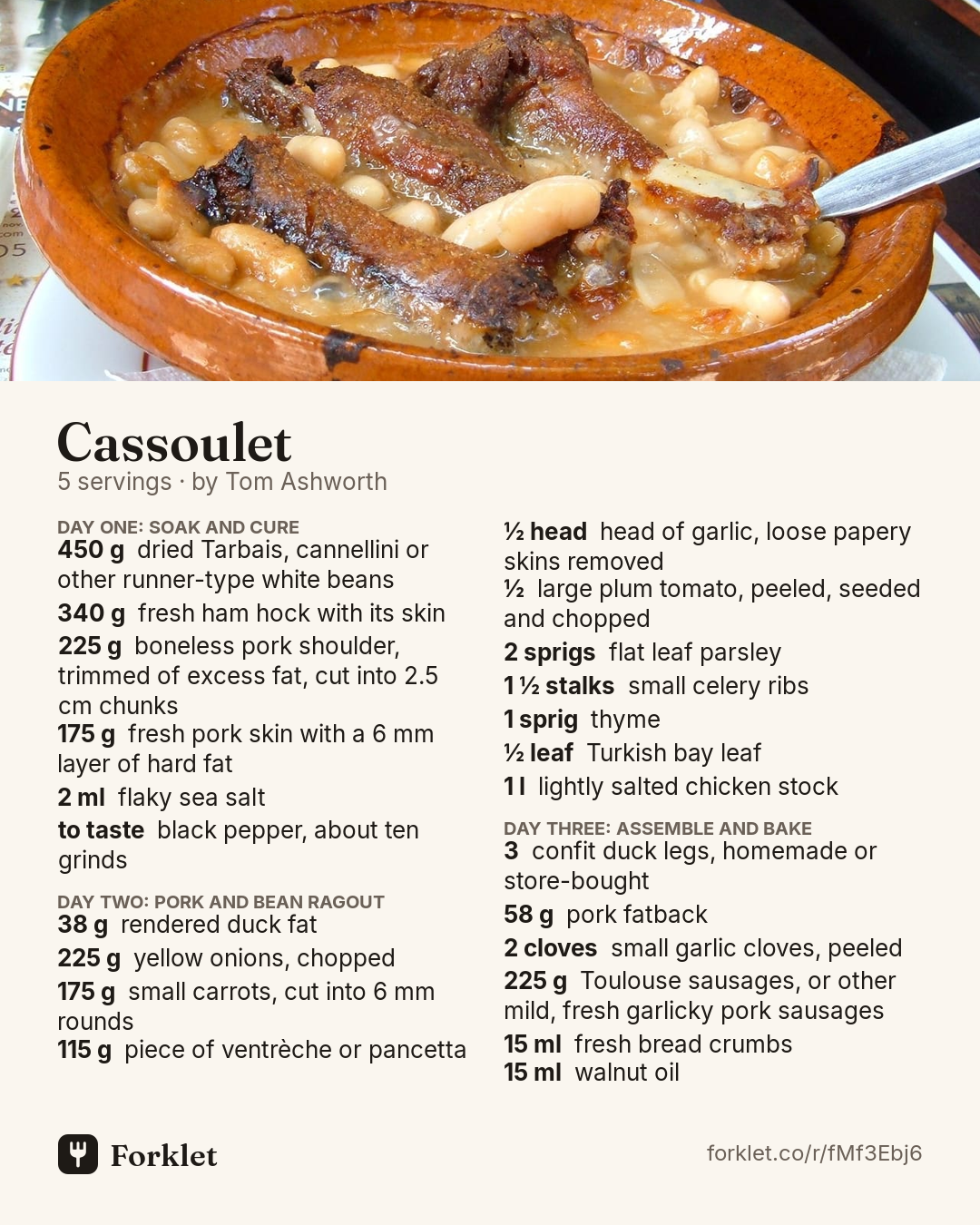
Quick CardCassoulet
5 servings
Day One: Soak and Cure
- 450 gdried Tarbais, cannellini or other runner-type white beans
- 340 gfresh ham hock with its skin
- 225 gboneless pork shoulder, trimmed of excess fat, cut into 2.5 cm chunks
- 175 gfresh pork skin with a 6 mm layer of hard fat
- 2 mlflaky sea salt
- black pepper, about ten grinds, to taste
Day Two: Pork and Bean Ragout
- 38 grendered duck fat
- 225 gyellow onions, chopped
- 175 gsmall carrots, cut into 6 mm rounds
- 115 gpiece of ventrèche or pancetta
- ½ headhead of garlic, loose papery skins removed
- ½large plum tomato, peeled, seeded and chopped
- 2 sprigsflat leaf parsley
- 1 ½ stalkssmall celery ribs
- 1 sprigthyme
- ½ leafTurkish bay leaf
- 1 llightly salted chicken stock
Day Three: Assemble and Bake
- 3confit duck legs, homemade or store-bought
- 58 gpork fatback
- 2 clovessmall garlic cloves, peeled
- 225 gToulouse sausages, or other mild, fresh garlicky pork sausages
- 15 mlfresh bread crumbs
- 15 mlwalnut oil
- Day One: Soak and Cure Rinse 450 g dried Tarbais, cannellini or other runner-type white beans and pick them over for grit. Cover with cold water by at least 5 cm (2 in) and leave to soak in the fridge overnight. 4 °C · 12 h
- Lay 340 g fresh ham hock with its skin, 225 g boneless pork shoulder and 175 g fresh pork skin with a 6 mm layer of hard fat in a shallow dish and sprinkle with 2 ml flaky sea salt and black pepper, about ten grinds. Cover and refrigerate overnight. 4 °C · 12 h
- Day Two: Pork and Bean Ragout Put the pork skin in a saucepan, cover with water by 2.5 cm (1 in) and bring to a simmer over medium heat. Cook for about 15 min, until plump and supple. Drain and cool.
- Roll the skin up with the skin side outwards and tie it securely with kitchen string. Tie 2 sprigs flat leaf parsley, 1 ½ stalks small celery ribs, 1 sprig thyme and ½ leaf Turkish bay leaf into a bouquet.
- Pat the ham hock and shoulder dry. Heat 38 g rendered duck fat in the large casserole over medium-high heat, add the shoulder and cook, turning now and then, for about 7 min, until lightly browned on all sides.
- Add 225 g yellow onions and 175 g small carrots and sauté, stirring, for about 5 min, until the onions are soft and golden.
- Nestle in the ham hock and 115 g piece of ventrèche or pancetta and cook, turning occasionally, for about 5 min, until they are a little browned at the edges.
- Add ½ head head of garlic and ½ large plum tomatoes and cook, stirring, for 1 min.
- Add the rolled pork skin and the herb bouquet and pour in 1 l lightly salted chicken stock. Bring to the boil, skimming off the scum, then turn the heat to low, cover and simmer gently for 1 h 30 min.
- Once the ragout has had its first hour, drain the beans, put them in a large saucepan and cover with fresh tepid water by 2.5 cm (1 in) to 5 cm (2 in). Bring slowly to the boil, skimming, then simmer for 3 min and drain immediately.
- Add the beans to the simmering pork, cover again and simmer until the beans are fully tender, at least 30 min and up to 2 h depending on their age and type.
- Take off the heat, let cool, cover and refrigerate overnight. 4 °C · 12 h
- Day Three: Assemble and Bake Heat the oven to 163 °C.
- Lift off the fat that has set on top of the chilled ragout, keeping two tablespoons of it aside. Set the ragout over low heat and warm it to room temperature.
- Warm 3 confit duck legs, homemade or store-bought to soften the fat: sealed pouches go into a bowl of hot water for about 10 min; homemade legs go on a foil-lined sheet in the oven. Pull the meat off in large chunks, discarding the skin, bones and any large dark veins.
- Pick out the head of garlic, squeeze the soft pulp from each clove back into the ragout and discard the herb bouquet. Lift out the ham hock and ventrèche, discard the bone, large fatty pieces and skin, and cut the meat into 2.5 cm (1 in) cubes.
- Untie the pork skin, cut it into 5 cm (2 in) pieces and lay them fat side down over the bottom of the earthenware cassole.
- Purée 58 g pork fatback with 2 cloves small garlic cloves in a food processor. Stir the purée into the ragout, bring to a simmer over low heat and cook for 30 min. Take off the heat and fold in the cubed hock and ventrèche.
- With a slotted spoon, spread half the ragout over the pork skin, letting the liquid drain back into the pot. Scatter over the duck, then cover with the rest of the ragout.
- Taste the cooking liquid (it rarely needs salt) and ladle in just enough to cover the beans, leaving at least 2.5 cm (1 in) of space below the rim. Dot the top with the reserved fat.
- Bake for 1 h 30 min. 163 °C
- Meanwhile prick 225 g Toulouse sausages, or other mild, fresh garlicky pork sausages in several places and brown them in a frying pan over medium-high heat, turning a few times, for about 10 min. Cut long ones into 7.5 cm (3 in) to 10 cm (4 in) pieces.
- Take the cassoulet out and lower the oven to 135 °C. Gently break the skin on the surface without disturbing the layers underneath, push the sausages partway down into the beans, evenly spaced, and dust with 15 ml fresh bread crumbs.
- Bake for 1 h more. For a darker crust, raise the heat to 204 °C after the first 30 min, and if it is still pale at the end, run it under the broiler for 2 min to 5 min with the rim about 18 cm (7 ⅛ in) from the element.
- Let the cassoulet rest for 20 min, on a cloth if the dish is earthenware. Drizzle with 15 ml walnut oil just before serving and ladle onto warm plates.
- Safety: Set a hot earthenware dish on a cloth or wooden board, never on a cold or wet surface, or it may crack. (The author)
- Safety: Whole cuts of pork should reach 63 °C (145 °F) at the centre, then rest 3 minutes. (USDA FSIS)
- Safety: Cool the ragout quickly and keep it in the fridge between days; bring it back to a full simmer on day three before it goes into the oven. (The author)
- Safety: Fresh sausage should reach 71 °C (160 °F) at the centre. (USDA FSIS)