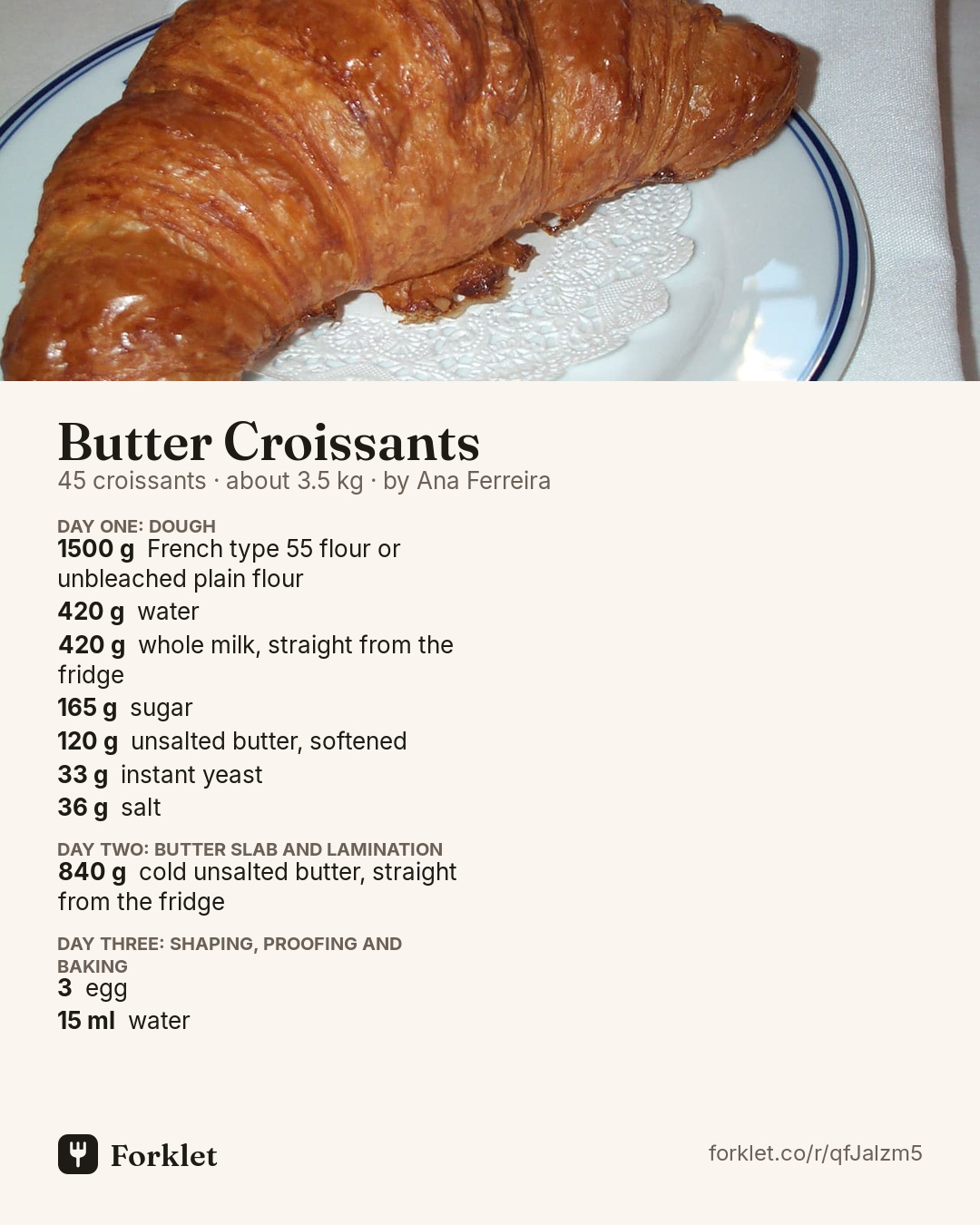
Quick CardButter Croissants
45 croissants · about 3.5 kg
Day One: Dough
- 1500 gFrench type 55 flour or unbleached plain flour
- 420 gwater
- 420 gwhole milk, straight from the fridge
- 165 gsugar
- 120 gunsalted butter, softened
- 33 ginstant yeast
- 36 gsalt
Day Two: Butter Slab and Lamination
- 840 gcold unsalted butter, straight from the fridge
Day Three: Shaping, Proofing and Baking
- Day One: Dough Put 1500 g French type 55 flour or unbleached plain flour, 420 g water, 420 g whole milk, straight from the fridge, 165 g sugar, 120 g unsalted butter, softened, 33 g instant yeast and 36 g salt in the mixer bowl and knead for 3 min on low to medium speed, just until the dough comes together.
- Shape the dough into a flat disc rather than a ball, so it is easy to roll into a square tomorrow. Put it on a plate, cover with cling film and refrigerate overnight. 4 °C · 12 h
- Day Two: Butter Slab and Lamination Cut 840 g cold unsalted butter lengthwise into slabs about 1.3 cm (½ in) thick and arrange them on waxed paper in a square of roughly 15 cm (6 in). Cover with a second sheet and pound with a rolling pin until about 19 cm (7 ½ in) square. Trim the edges straight, lay the trimmings on top and pound gently into a neat 17 cm (6 ⅔ in) square. Wrap and refrigerate until needed. 5 min
- Lightly flour the worktop and roll the cold dough disc into a 26 cm (10 ¼ in) square of even thickness.
- Lay the butter slab on the dough turned diagonally, so a corner of the butter points towards you. Fold each corner of the dough over the butter so the points meet in the middle, with the edges just overlapping, and press the seams together with the palm of your hand.
- With a lightly floured pin, roll the package from the centre outwards into a rectangle of 20 cm (7 ¾ in) by 60 cm (23 ⅔ in), aiming to make it longer rather than wider. Fold it in thirds like a letter, cover and refrigerate for 30 min.
- Give the dough a quarter turn so an open end faces you, roll it out again to 20 cm (7 ¾ in) by 60 cm (23 ⅔ in), fold in thirds, cover and refrigerate for 30 min.
- Turn, roll and fold one last time in the same way, then wrap the dough and refrigerate it overnight. 4 °C · 22 h
- Day Three: Shaping, Proofing and Baking On a lightly floured worktop, roll the dough very gently into a long strip 20 cm (7 ¾ in) wide and 110 cm (43 ⅓ in) long. If it resists, fold it up, refrigerate for 10 min to 20 min and try again. Lift the strip a few centimetres off the worktop so it can shrink back, then trim the ends straight, leaving about 100 cm (39 ⅓ in).
- Mark the top edge every 12.5 cm (5 in) with the pizza wheel. Mark the bottom edge first at 6.3 cm (2 ½ in), then every 12.5 cm (5 in) from there, so the marks are staggered. Cut diagonals from each top mark down to the bottom marks, first in one direction and then the other, to give 45 triangles.
- Cut a 1.5 cm (⅝ in) notch in the middle of the short side of each triangle and gently stretch each one to about 25 cm (9 ¾ in) long, by hand or with barely any pressure from the rolling pin. Roll up from the notched end, pulling the two wings outwards from the centre, tightly at first so the layers stick, and finish with the point underneath. 15 min
- Set the croissants on trays lined with paper, with plenty of space between them. Beat 3 eggs with 15 ml water until smooth and brush on a first thin coat; no need to cover them.
- Proof in a draught-free spot at 24 °C to 26 °C for about 2 h. Any warmer and the butter will start to leak out.
- Towards the end of the proof, heat the oven to 220 °C (220 °C fan).
- Brush with a second thin coat of egg wash and bake at 200 °C for 15 min to 20 min, turning the oven down a notch if they colour too fast.
- Leave on the sheet for a few minutes, then move to a rack. Eat while still warm. 5 min
- Safety: Egg dishes should reach 71 °C (160 °F) at the centre. (USDA FSIS)